Group Members & Projects
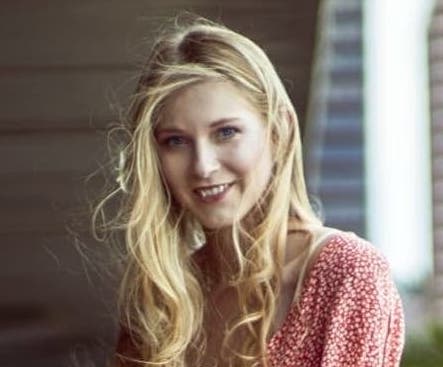 Denise Kamp
Denise is a graduate student studying the instabilities of an atomic Bose-Einstein condensate (BEC) in a rotating
toroidal trap. An instability can arise because a vortex state in this system decays to a non-rotating state,
a process controlled by
tuning the interaction strength and the rotation speed.
A theoretical description of the process can obtained via the Bogoliubov method that describes elementary excitations
of the BEC which have complex or negative energies in the presence of dynamical or energetic instabilities.

Liam Farrell
Liam is a graduate student studying Hawking radiation from acoustic black holes. These fluid analogues
of gravitational black holes can be formed in flowing Bose-Einstein condensed gases, where an effective event horizon
is formed for sound waves propagating against the fluid flow if the local flow speed exceeds the speed of sound in the gas. Remarkably, Hawking radiation is
produced near this acoustic horizon as pairs of sound waves.
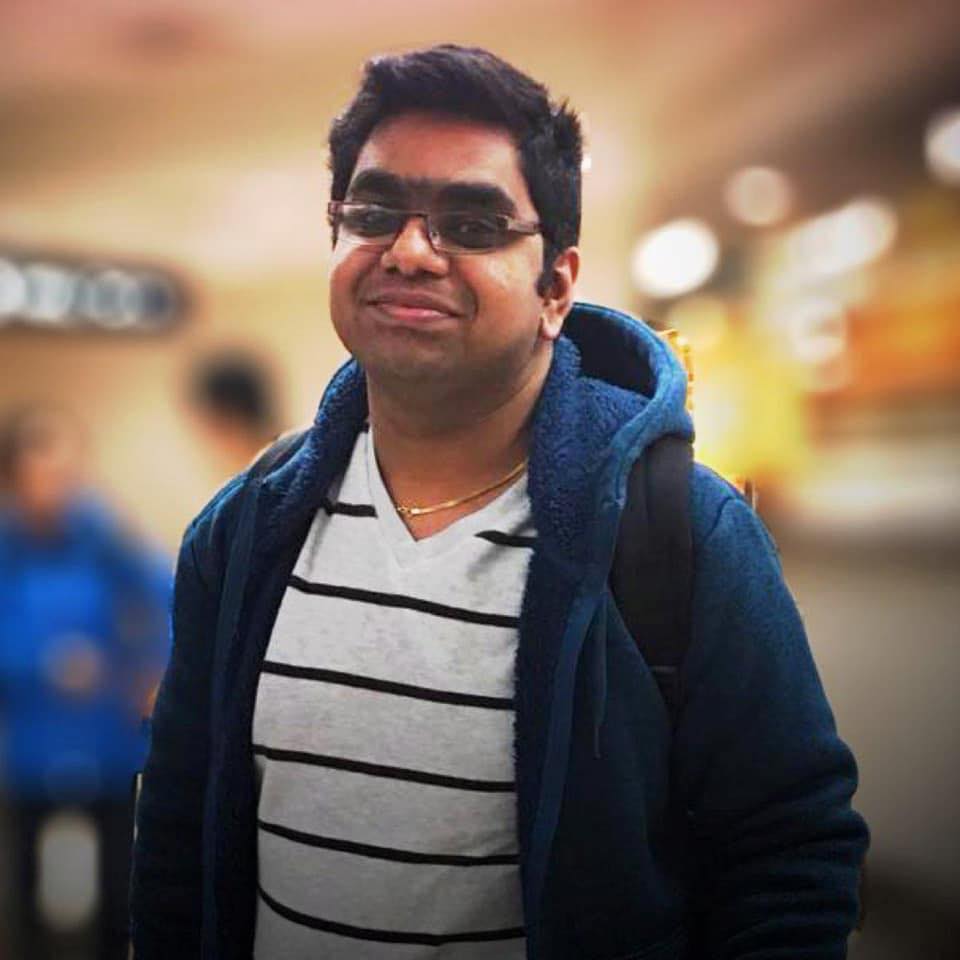 Sriram Sundaram
Sriram is a graduate student currently working on developing a classical field theory formalism for Schwinger pair
production (this is the vacuum instability that produces particle-antiparticle pairs in the presence of a static external
electric field). We intend to describe pair creation as arising from an
added non-unitary boundary condition and thereby uncover hidden symmetries of the problem. I am also interested
in studying instabilities and singularities in related optical systems.
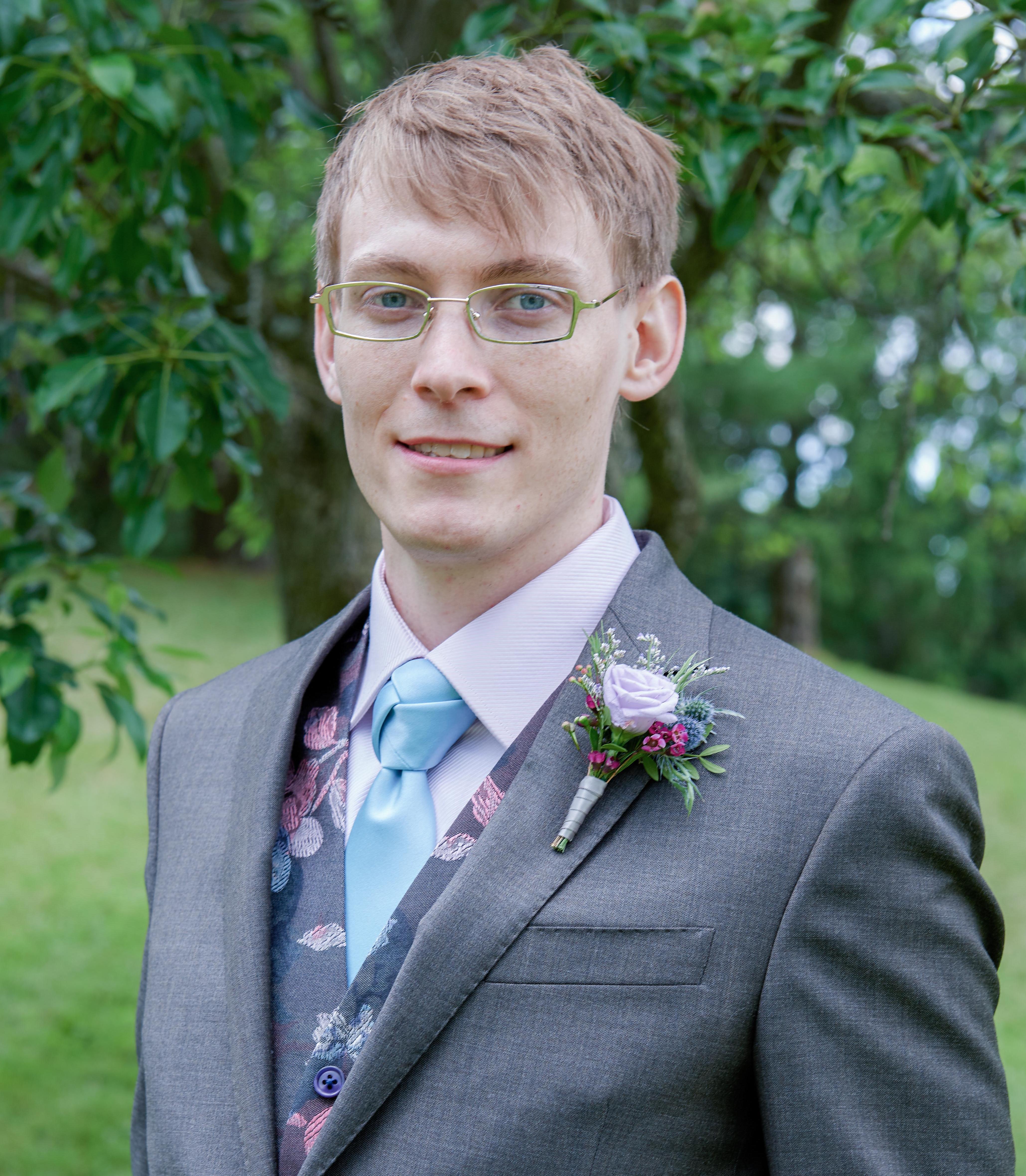 Josh Hainge
Josh is a graduate student studying atom-light interactions and the Abraham-Minkowski controversy (momentum of a photon in a medium). Josh's speciality is to take relativistic effects into account. Another project concerns branched flow in quantum waves. This phenomenon is better known in tsunamis and related focused or channeled waves, but also occurs in quantum systems.
Former members:
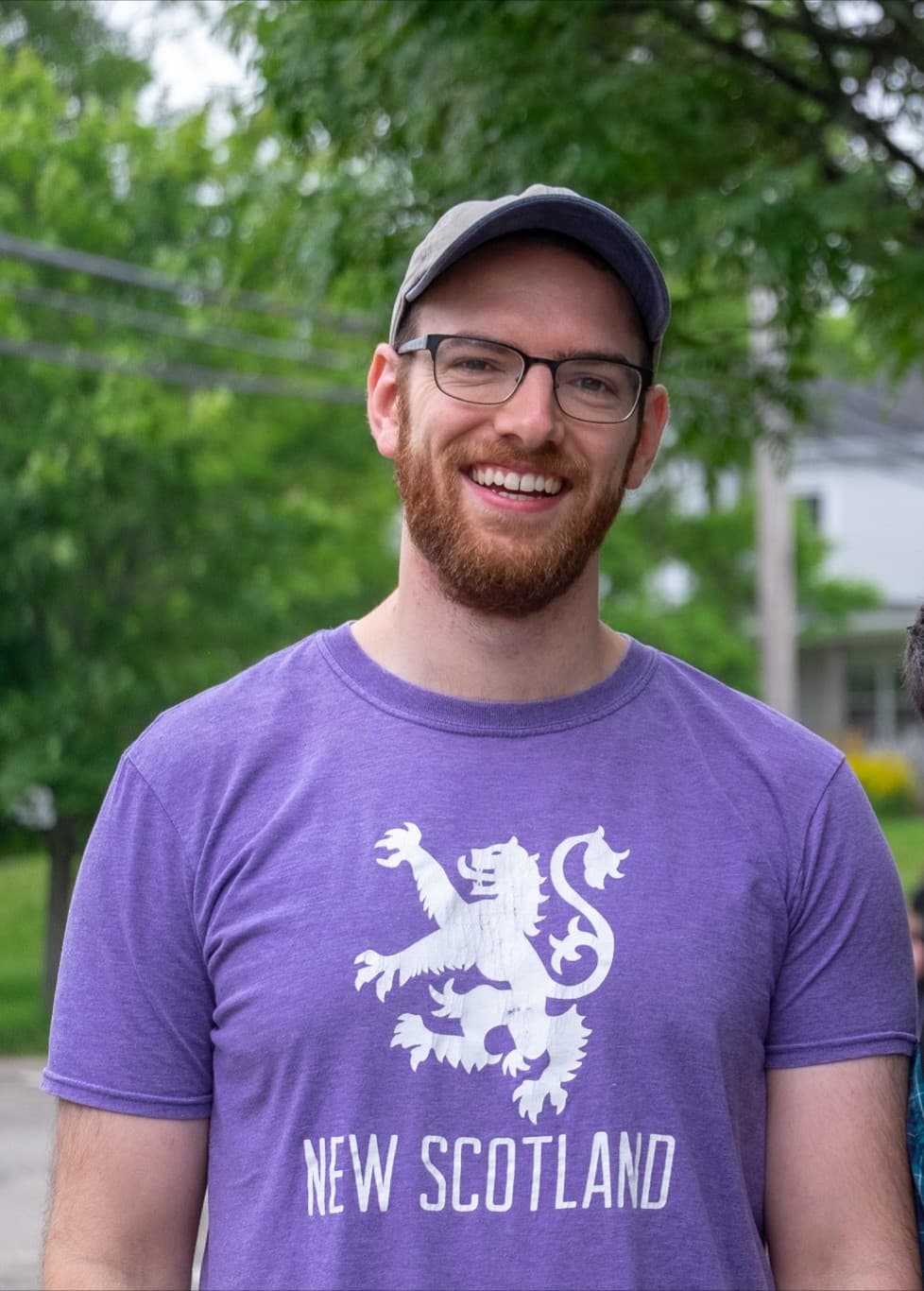 Wyatt Kirkby(--> Postdoctoral Fellow at the University of Innsbruck, NSERC postdoctoral fellow at the University of Heidelberg)
Wyatt is a graduate student studying caustics in many-body quantum dynamics. His recent projects include
the study of `quantum light-cones' in quenched spin chains, where the spread of correlations exhibit
universal behaviour governed by catastrophe theory, and the study of caustics in dynamics of three-mode models, such as a spinor BEC.
Matthew Richards (-->mathematics tutor)
Matt is a graduate student working on the dynamics of quantum many-body systems near phase transitions. Inspired by the Kibble-Zurek
theory, he is using a combination of numerical techniques and analytic calculations to look for scaling propertiesof these systems,
especially in the presence of long-rang interactions.
 Ryan Plestid (-->Intensity Frontier Fellow at Fermilab) Ryan Plestid (-->Intensity Frontier Fellow at Fermilab)
Ryan is a graduate student studying quantum many-body systems with long-range interactions, especially the quantum version
of the Hamiltonian Mean-Field (HMF) model which describes quantum rotors with all-to-all XY coupling. This system, which can be realized using
quantum gases in optical cavities, gives us the
opportunity to explore phenomena such as ``violent relaxation'' in the quantum regime. Violent relaxation, which is closely related to Landau damping, is
a relaxation mechanism known in classical gravitationally bound systems.
Aaron Goldberg (-->graduate student at the University of Toronto)
Aaron is doing his undergraduate thesis on the problem of analogue Hawking radiation in flowing Bose-Einstein condensates
and the connection between this problem and quantum catastrophes.
Alan Morningstar (-->PSI Masters programme at the Perimeter Institute-->graduate student at Princeton University)
Alan is doing his undergraduate thesis on the problem of quantum measurement and whether it can be interpreted as a phase transition.
This interpretation may allow speed limits to be put on how fast we can perform certain measurements (and still obtain accurate results).
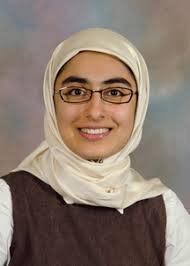 Dr. Asma Al-Qasimi (-->M. Hildred Blewett Fellow at the University of Rochester) Dr. Asma Al-Qasimi (-->M. Hildred Blewett Fellow at the University of Rochester)
Asma is a postdoctoral fellow working on the problem of quantum caustics and their stability to peculiarly quantum
effects such as decoherence (such as occurs during a continuous measurement). According to catastrophe
theory, caustics have the property of structural stability which means stability under perturbations.
Both ray and wave caustics have this property which explains why caustics are so ubiquitous in nature,
but much less is known about the stability of quantum caustics which are singularities than occur in quantum fields.
 Jesse Mumford (-->Faculty member in the Department of Science and Engineering Physics, Red Deer College) Jesse Mumford (-->Faculty member in the Department of Science and Engineering Physics, Red Deer College)
Jesse is a graduate student studying the problem of impurity atoms in Bose-Einstein condensates (BECs). For example, a single
impurity atom in a BEC in a double well potential can be considered as a paradigm for the measurement problem in quantum
mechanics: the impurity acts as a microscopic quantum system (in fact, a spin) that we want to measure and the BEC acts as a
macroscopic measuring device.
website: Dr Jesse Mumford
 Faiyaz Hasan (-->Paper [Director of Labs]) Faiyaz Hasan (-->Paper [Director of Labs])
Faiyaz is a graduate student working on modelling on-demand transfer of light between optical cavities or waveguides. This has
applications in quantum information processing. The basic idea is to take advantage of avoided crossings between optical modes
in order to transfer light between two waveguides, either moving a mirror or changing the refractive index of one of the
guides. One of the key questions is whether this can be done adiabatically.
 Nick Miladinovic (-->Preteckt [machine learning and data science]) Nick Miladinovic (-->Preteckt [machine learning and data science])
Nick is a graduate student and is working on cavity-QED. His project concerns the Abraham-Minkowski paradox which
refers to two conflicting results for the momentum of a photon inside a dielectric medium. Normally, a single atom has
an absolutely negligible affect on a beam of light, but inside a high-Q optical cavity the atom and the light can
become strongly coupled. We are investigating whether a single atom in cavity can significantly change the momentum of
cavity photons, and if so, under what circumstances one would expect the Abraham or the Minkowski results. This work
has implications for using intra-cavity Bloch oscillations of cold atoms for measuring forces such as gravity.
 Prasanna Venkatesh Balasubramanian (-->Faculty member in the Department of Physics, IIT Gandhinagar) Prasanna Venkatesh Balasubramanian (-->Faculty member in the Department of Physics, IIT Gandhinagar)
Prasanna is a graduate student and is working on ultra-cold atoms inside
optical cavities. This is a project that mixes cavity quantum optics
with ultra-cold atoms. In the presence of an external force such as gravity
atoms in an optical lattice will undergo Bloch oscillations whose period
will tell us the strength of the force. We hope this system might allow
precision measurements of gravity at small distances (<1mm) where
it is least well known.
website: Dr Prasanna Venkatesh B
 Daniel Thompson (-->Ontario of College of Teachers) Daniel Thompson (-->Ontario of College of Teachers)
Dan is an undergraduate student enrolled in the coop physics program at McMaster. He is spending one of his coop terms
doing research on ultracold atoms in double well potentials, with a special focus on calculating the density of quantum
states near a classical separatrix of the motion. This is part of a bigger project trying to understand the
quantum-to-classical transition in many body systems.
 Ben Criger (-->graduate student at the IQC in Waterloo) Ben Criger (-->graduate student at the IQC in Waterloo)
Ben
is doing his undergraduate thesis project on exchange interactions between
dipolar atoms in ultra-cold Bose and Fermi gases. Dipole-dipole interactions
are partly repulsive and partly attractive. It has been suggested (Huang
1987, Nozieres 1995) that attractive interactions can lead to fragmentation
in Bose-Einstein condensates (i.e. not just one state is occupied macroscopically)
and we are investigating these effects for the case of the dipolar interaction.
Matthew Farrar (-->graduate student at Cornell)
Matt's project involves simulating beam splitters for Bose-Einstein condensates.
The idea is to raise a central barrier in the BEC in an adiabatic way,
i.e. without generating excitations, if possible. The BEC is described
by the Gross-Pitaevskii equation (a type of non-linear Schrodinger equation)
and the nonlinearity plays a crucial role. This is relevant to experiments
that will use BECs for interferometry, i.e. matter-wave interferometry
that makes use of the wave nature of quantum particles.
 Graham Krahn (-->graduate student at UC Riverside) Graham Krahn (-->graduate student at UC Riverside)
Graham is an undergraduate student at UBC and spent summer 2008 working at McMaster on the theory of atomic Josephson junctions (JJs). The first JJs were made in the 1960s from two metallic superconductors separated by a thin layer of insulator through which electrons can quantum mechanically tunnel. They are a paradigm of quantum coherence phenomena in many-electron systems and Brian Josphson won the Nobel prize for proposing them. JJ's can also be made from two Bose-Einstein condensates trapped in a double-well potential. In atomic systems one has the advantage of much greater control over the system parameters and also the types of measurement one performs (recall that measurements play a very important role in quantum theory which is not yet competely understood).
Yohan Yee (-->graduate student at the University of Toronto)
Yohan is doing his undergraduate thesis on the problem of a Bose-Enstein condensate in a triple well
potential using the Bose-Hubbard model. He is examing the higher catastrophes that occur during dynamics in this system following a quench.
 Frank Mulansky (-->graduate student at the Technical University of Dresden) Frank Mulansky (-->graduate student at the Technical University of Dresden)
Frank is visiting our group for six months from the Dresden University of Technology in Germany. He is studying the
problem of an impurity atom in a BEC in a double well potential. Our view of this system is that the BEC acts like a
measuring device which measures the position of the impurity (i.e. left or right well). The BEC can be tuned between
being a classical or a quantum system depending upon the number of atoms it contains.
 Dr Nicholas Parker (-->Faculty member in the Department of Mathematics, University of Newcastle) Dr Nicholas Parker (-->Faculty member in the Department of Mathematics, University of Newcastle)
Nick
is a Commonwealth fellow who is researching Bose-Einstein condensates
with dipole-dipole interactions. The long-range and anisotropic nature
of the dipolar interactions leads to a number of novel effects in these
systems including collapse instabilities which Nick is tackling.
website: Dr Nicholas Parker
|